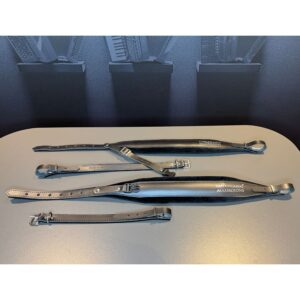
Why an Accordion Can Deteriorate Even When It Is Not Being Played
By Uroš R. Kobal | AccordionShop.ca
One of the most common misconceptions about accordions is that an instrument which has not been played for many years should still be in excellent condition. After all, if nobody has been using it, what could possibly have worn out?
Unfortunately, accordions do not work that way.
An accordion is a complex musical instrument containing hundreds of individual components made from wood, metal, leather, felt, wax and other materials. These materials respond differently to age, temperature, humidity and storage conditions.
An accordion that has been sitting untouched in its case for twenty years may require considerably more attention than an instrument that has been played regularly and properly maintained.
Understanding why this happens can help owners make better decisions about storing, purchasing and maintaining their instruments.
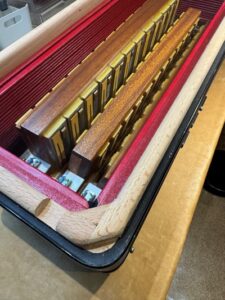
Inside an acoustic accordion: reed blocks, wooden construction and bellows.
An Accordion Is More Than Its Appearance
A beautifully preserved accordion can be misleading. The exterior may look immaculate. The keys may be perfectly white, the decorative finish may shine, and the bellows may appear almost new.
Yet none of these observations tells us very much about the condition of the instrument’s internal components. An accordion can contain hundreds of reeds, valves and mechanical components that must work together with remarkable precision.
When evaluating an older instrument, its internal condition is often far more important than its cosmetic appearance. This is particularly relevant when purchasing an accordion that has spent many years in storage.
Reed Wax: A Material That Changes With Age
In many traditional accordions, metal reed plates are secured to wooden reed blocks using a specialized wax compound. This wax helps secure the reed plates and maintain an airtight seal between the plates and the reed blocks.
Over time, however, wax can change its physical properties. Depending on its composition, age and exposure to different environmental conditions, it may become brittle, develop cracks or lose some of its original adhesion. These changes do not necessarily occur uniformly throughout the instrument.
An accordion may therefore appear to function reasonably well while some of its internal components are no longer in satisfactory condition. The condition of reed wax is one of several important considerations during the professional evaluation of an older accordion.
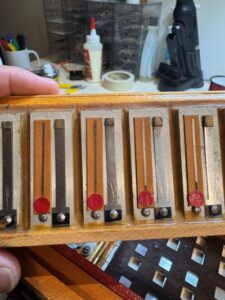
Reed plates, leather valves and mounting wax on a wooden reed block during workshop inspection.
Reed Valves: Small Components With a Significant Responsibility
Accordion reeds are accompanied by small valves, traditionally made from leather or various synthetic materials. Although these components are relatively simple in appearance, they play an essential role in controlling airflow and supporting proper reed operation.
With age, leather valves can lose flexibility, curl or become distorted. Synthetic valves can also change over time, depending on their material and storage conditions.
When valves no longer perform as intended, the consequences may include changes in reed response, unwanted air movement and irregularities in sound production. A musician may notice that certain notes respond differently from others or that the instrument no longer behaves as consistently as expected.
These symptoms do not automatically establish the cause. Similar playing problems can originate from several different components. That is why an accurate diagnosis matters.
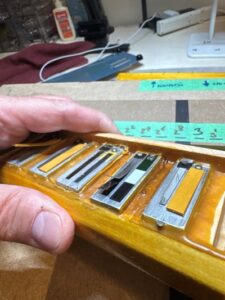
Lifted and deformed reed valves observed during an accordion restoration at AccordionShop.ca.
Temperature and Humidity Matter
Accordions combine materials with very different physical characteristics. Wood reacts to changes in humidity. Leather can absorb and release moisture. Metal components may be affected by corrosion, while adhesives, felt and other materials can change as they age.
When an instrument is exposed to substantial temperature fluctuations or unsuitable humidity levels, these materials do not necessarily respond in the same way. Over time, the resulting changes can affect mechanical alignment, sealing and general reliability.
Storing an accordion in a damp basement, an unheated garage or another environment with significant fluctuations can create problems that are not immediately visible. A stable, reasonably controlled indoor environment is generally preferable for long-term storage.
The Bellows: The Heart of the Instrument’s Air Supply
The bellows provide the airflow necessary to activate the reeds and allow the musician to control dynamics and expression. Even when an accordion is not being played, components associated with the bellows and its airtightness can deteriorate.
Ageing materials, changes in adhesives and the condition of seals can all influence the instrument’s ability to retain air. An accordion that loses air unnecessarily may become more difficult to control, particularly during passages requiring subtle dynamic expression.
Poor air retention does not always mean the bellows themselves are defective. Air leakage can originate from several locations within the instrument, making a comprehensive assessment essential.
Why Regular Playing Can Be Beneficial
An accordion that is played regularly is not automatically in better condition than one that has been stored. However, regular use has one important advantage: changes in the instrument’s behaviour are more likely to be noticed.
A musician familiar with an instrument may recognize when a note becomes less responsive, a key begins to behave differently or the bellows require more effort than before. By contrast, an accordion that remains untouched for many years may develop several unrelated issues without anyone noticing.
Should an Older Accordion Be Restored?
Not every older accordion requires extensive restoration. Some instruments have been exceptionally well preserved and may need only limited professional attention. Others may require significant work before they can perform reliably.
The appropriate recommendation depends on the instrument’s construction, quality, internal condition, intended use and the owner’s expectations. A historically interesting accordion may deserve a different approach from an instrument intended for regular professional performance. An accordion with sentimental value may also justify different considerations.
There is no single recommendation suitable for every accordion.
Experience Makes the Difference
Evaluating an accordion requires more than identifying an obvious defect. A professional assessment considers how the instrument’s components interact, whether observed problems are isolated or widespread, and what standard of performance the owner expects.
In my work with accordions, I believe it is important to understand the instrument as a complete mechanical and musical system rather than simply addressing the first visible symptom. This approach helps ensure that recommendations are appropriate to the individual instrument and its owner.
Final Thoughts
An accordion does not stop ageing simply because nobody is playing it. Time, environmental conditions and the natural behaviour of its materials continue to influence its condition.
An attractive exterior and a history of limited use do not guarantee good internal condition. Understanding this distinction can prevent disappointment and help preserve instruments for future generations of musicians.
If you own an older accordion, have inherited one, or are considering purchasing an instrument stored for many years, a professional assessment can provide valuable information about its condition and suitability for your needs.
Uroš R. Kobal | AccordionShop.ca — Professional Accordion Service, Tuning and Restoration | Mississauga, Ontario, Canada